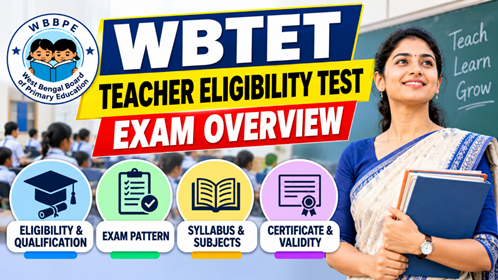
The West Bengal Teacher Eligibility Test (WBTET) is a qualifying examination for candidates aspiring to become teachers in primary and upper-primary schools in West Bengal. It assesses a candidate’s knowledge of child development, teaching methods, languages and subject-specific concepts.
The examination is conducted by the West Bengal Board of Primary Education (WBBPE) for primary-level teacher eligibility. The Upper Primary TET is conducted under the applicable state recruitment framework. Qualifying TET makes a candidate eligible to apply for relevant teacher recruitment; it does not itself guarantee a teaching appointment.
Key Takeaways
- WBTET is a qualifying examination for candidates seeking teaching positions in eligible schools in West Bengal.
- The primary-level TET-2023 conducted by WBBPE covered Classes I to V.
- The examination consisted of 150 multiple-choice questions carrying 150 marks.
- Major sections included Child Development and Pedagogy, Language I, Language II, Mathematics and Environmental Studies.
- The qualifying benchmark was 60% for general candidates and 55% for specified reserved and other eligible categories under the 2023 notification.
- The TET certificate is valid for a lifetime under the TET-2023 guidelines.
- Qualifying WBTET does not guarantee appointment; candidates must separately participate in the applicable teacher recruitment process.
Teaching Levels and Responsibilities
Primary Teacher (Classes I–V)
Candidates qualifying the primary-level TET may become eligible to apply for primary teacher recruitment, subject to the prescribed academic and professional qualifications.
The responsibilities of a primary teacher may include:
- Teaching foundational subjects such as languages, Mathematics and Environmental Studies.
- Developing basic reading, writing and numeracy skills among children.
- Preparing lesson plans and classroom activities.
- Assessing students’ learning progress through classroom evaluation.
- Supporting children’s social, emotional and intellectual development.
- Maintaining attendance, academic records and student-related documents.
- Communicating with parents and participating in school activities.
The exact responsibilities depend on the school, class allocation and applicable service rules.
Upper Primary Teacher (Classes VI–VIII)
Upper-primary teaching involves subject-based instruction for students in the middle-school stage.
Responsibilities may include:
- Teaching the relevant subject according to the prescribed curriculum.
- Preparing lesson plans and conducting classroom assessments.
- Helping students develop conceptual understanding and analytical skills.
- Maintaining academic records and monitoring student progress.
- Providing academic guidance and remedial support.
- Participating in school-level activities and coordination.
Eligibility and Qualification
Candidates applying for WBTET must satisfy the academic and professional qualification requirements prescribed under the applicable National Council for Teacher Education (NCTE) guidelines and WBBPE notification.
Primary TET (Classes I–V)
As specified in the WBTET-2023 notification, eligible qualification routes included:
- Higher Secondary (or equivalent) with at least 50% marks and a 2-year Diploma in Elementary Education (D.El.Ed.).
- Higher Secondary with at least 50% marks and a 4-year Bachelor of Elementary Education (B.El.Ed.).
- Higher Secondary with at least 50% marks and a Diploma in Education (Special Education) recognised by the Rehabilitation Council of India.
- Graduation with a 2-year Diploma in Elementary Education.
A 5% relaxation in the required Higher Secondary marks was provided for the specified categories under the 2023 notification. Candidates must check the latest notification before applying.
Exam Pattern and Syllabus
The WBTET-2023 Primary examination followed an objective-type format.
| Subject | Questions | Marks |
| Child Development and Pedagogy | 30 | 30 |
| Language I | 30 | 30 |
| Language II (English) | 30 | 30 |
| Mathematics | 30 | 30 |
| Environmental Studies | 30 | 30 |
| Total | 150 | 150 |
Examination Details
- Question Type: Multiple Choice Questions (MCQs).
- Total Marks: 150.
- Duration: 150 minutes (2 hours 30 minutes).
- Negative Marking: No negative marking.
- Language I: Bengali, Hindi, Urdu, Nepali, Santhali, Oriya or Telugu.
- Language II: English.
- Question Paper: Bilingual (Bengali and English), except the language papers.
West Bengal Board of Primary Education
Major Syllabus Areas
- Child Development and Pedagogy: Child psychology, learning theories, inclusive education and teaching-learning processes.
- Language I: Reading comprehension, grammar, language development and language pedagogy.
- Language II: English comprehension, communication skills and language teaching methods.
- Mathematics: Mathematical concepts, problem-solving and mathematics pedagogy.
- Environmental Studies: Environmental concepts, social and natural surroundings and EVS pedagogy.
West Bengal Board of Primary Education
Salary Structure and Monthly Earnings
WBTET itself does not carry a salary or pay scale. It is an eligibility examination, not a direct recruitment examination.
Candidates who qualify WBTET may apply for primary teacher recruitment when vacancies are notified and when they meet the prescribed recruitment conditions.
The salary of a selected teacher depends on:
- The teaching post and school level.
- The applicable West Bengal Government pay rules.
- Basic pay and admissible allowances.
- Appointment conditions and service rules.
What Makes Up a Teacher’s Monthly Salary?
After appointment, a government-aided or government-sponsored school teacher may receive applicable salary components such as:
- Basic Pay: Determined by the applicable pay level and recruitment rules.
- Dearness Allowance (DA): Payable at the applicable government rate.
- House Rent Allowance (HRA): Subject to government rules and eligibility.
- Medical Allowance (MA): As admissible under applicable provisions.
- Other Benefits: Depend on the post, service conditions and relevant government rules.
The actual gross and in-hand salary can only be determined from the applicable recruitment notification and pay rules.
Certificate Validity and Career Opportunities
TET Certificate Validity
Under the WBTET-2023 guidelines:
- The TET qualifying certificate is valid for a lifetime.
- There is no restriction on the number of attempts.
- Candidates who have already qualified may reappear in future TET examinations to improve their scores.
- Qualifying TET does not guarantee recruitment or appointment.
Career Opportunities
After qualifying the relevant TET and completing the applicable recruitment process, candidates may pursue teaching positions according to their eligibility.
- Primary Teacher: Teaching Classes I to V.
- Upper Primary Teacher: Teaching Classes VI to VIII, subject to the relevant TET and recruitment requirements.
- Special Education Teacher: Opportunities may be available through separate recruitment processes subject to prescribed qualifications.
- Further Academic Growth: Teachers may pursue additional qualifications and professional development as permitted under service rules.
Career Advancement
Career progression after appointment may include:
- Senior teaching responsibilities based on experience and departmental rules.
- Participation in academic coordination and school administration.
- Eligibility for higher responsibilities or promotional posts, subject to applicable service rules and vacancies.
- Opportunities for professional development and further qualifications.
TET qualification alone does not provide promotion or a higher designation.
Work Profile and Work-Life Balance
Teaching in government and government-aided schools generally involves classroom instruction, academic planning and student development.
Teachers may be responsible for:
- Conducting regular classroom lessons.
- Preparing lesson plans and teaching materials.
- Evaluating students through tests and classroom activities.
- Maintaining attendance and academic records.
- Supporting students who require additional academic assistance.
- Participating in parent-teacher meetings and school programmes.
- Performing academic and administrative duties assigned by school authorities.
The workload depends on the school, teaching level, subject allocation and administrative requirements.
Apart from classroom teaching, teachers may be assigned examination duties, election-related responsibilities, census work and other government duties when required.
The profession generally follows a school-based working schedule, although preparation, evaluation and administrative responsibilities may extend beyond regular classroom hours.
Candidates should consider teaching responsibilities, professional development opportunities and the recruitment process alongside long-term career prospects.