
PHYSICS
Unit and Measurement: In Physics, measurement is the process of comparing a physical quantity with a standard unit. A unit is a fixed standard used to express the magnitude of a physical quantity, such as metre (m) for length and kilogram (kg) for mass.
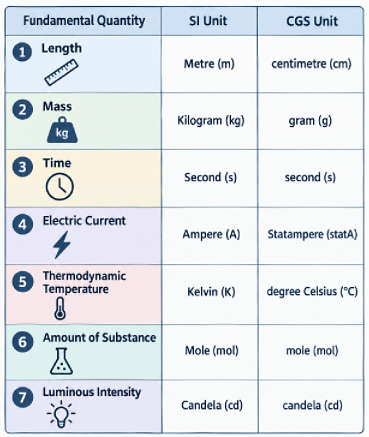
Important Derived Units, Word Formulas & Dimensions
| Physical Quantity | Word Formula | Dimensional Formula | SI Unit (Special Name) | CGS Unit | Key Exam Notes |
| Force | Mass Acceleration | [MLT-2] | Newton | Dyne | 1 Newton = 105 dynes |
| Work / Energy | Force Displacement | [ML2 T-2] | Joule | Erg | 1 Joule = 107 ergs |
| Power | Work Done Time Taken | [ML2 T-3] | Watt | Erg per second | 1 Horsepower = 746 Watts |
| Pressure / Stress | Force Area | [M L-1 T-2] | Pascal | Barye | 1 bar = 105 Pascals |
| Linear Momentum | Mass Velocity | [M L T-1] | Newton-second | Gram Centimetre per second | Same dimension as Impulse (Force × Time Interval) |
| Frequency | One ÷ Time Period | [M0 L0 T-1] | Hertz | Cycles per second | Reciprocal of time |
| Electric Charge | Electric Current × Time | [AT] | Coulomb | Statcoulomb | 1 Coulomb 3 × 10⁹ Statcoulombs |
| Potential Difference (Voltage) | Work Done ÷ Electric Charge | [M L2 T-3 A-1] | Volt | Statvolt | 1 Statvolt = 300 Volts |
| Electric Resistance | Potential Difference ÷ Electric Current | [M L2 T-3 A-2] | Ohm | Statohm | Derived from Ohm’s Law |
| Electric Capacitance | Electric Charge ÷ Potential Difference | [M-1 L-2 T4 A2] | Farad | Statfarad | Microfarad and Picofarad are practical units |
| Magnetic Flux | Magnetic Field × Area | [M L2 T-2 A-1] | Weber | Maxwell | 1 Weber = 108 Maxwells |
| Magnetic Field Strength | Force ÷ (Electric Current × Length) | [M L0 T-2 A-1] | Tesla | Gauss | 1 Tesla = 104 Gauss |
| Inductance | (Induced Voltage × Time) ÷ Change in Current | [M L2 T-2 A-2] | Henry | Abhenry | 1 Henry = 1 Weber per Ampere |
| Surface Tension | Force ÷ Length | [M L0 T-2] | Newton per metre | Dyne per centimetre | 1 Newton per metre = 103 dynes per centimetre |
| Viscosity (Dynamic) | (Force × Distance) ÷ (Area × Velocity) | [M L-1T-1] | Pascal-second | Poise | 1 Pascal-second = 10 Poise |
Key Constants
| Physical Constant | Word Formula | Dimensional Formula | SI Unit |
| Universal Gravitational Constant | (Gravitational Force × Distance squared) ÷ (First Mass × Second Mass) | [M-1 L3 T-2] | Newton metre2/kilogram2 |
| Planck’s Constant | Energy of a Photon ÷ Frequency of Radiation | [M L2 T-1] | Joule second (Same as Angular Momentum) |
| Universal Gas Constant | (Pressure × Volume) ÷ (Amount of Substance in Moles × Absolute Temperature) | [M L2 T-2 K-1 mol-1] | Joule per mole per Kelvin |