
Pedagogy of Language Development
Pedagogy of Language Development: Acquisition vs Learning
Fundamental Concepts
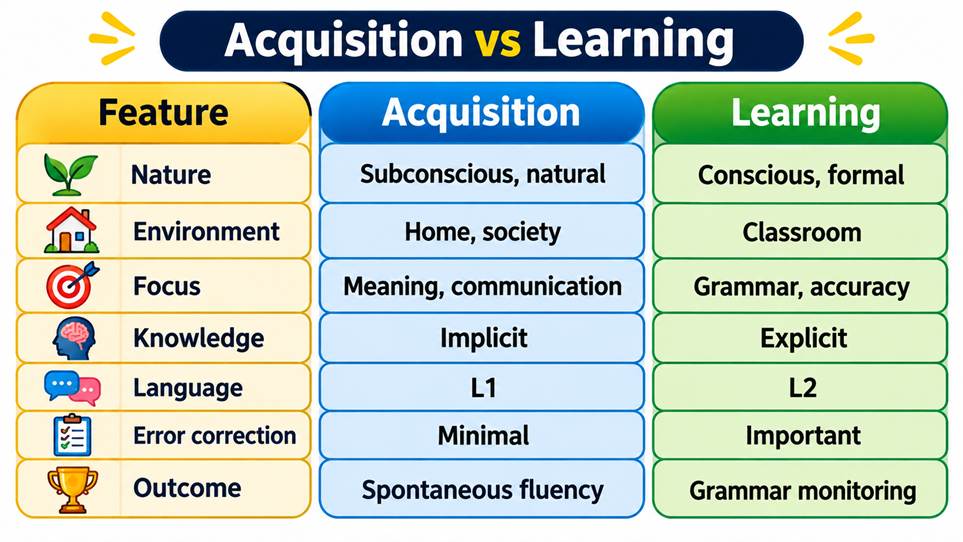
Language Acquisition
- Natural, subconscious and informal process.
- Usually develops through exposure to meaningful communication.
- Generally associated with mother tongue / First Language (L1).
- No formal grammar instruction required.
Language Learning
- Conscious and formal process, usually in classrooms.
- Involves grammar rules, sentence structures and vocabulary.
- Develops explicit knowledge about language.
- Generally associated with Second / Foreign Language (L2).
Major Theories
Stephen Krashen – Acquisition-Learning Hypothesis
- Two systems: subconscious Acquisition and conscious Learning.
- Monitor Hypothesis: Learned grammar checks and corrects acquired speech.
- Input Hypothesis: Comprehensible Input (i+1), slightly above current level, promotes acquisition.
- Affective Filter: Anxiety and low confidence block acquisition.
Noam Chomsky – Nativist Theory
- Humans have an innate language-learning ability.
- LAD: Language Acquisition Device.
- UG: Universal Grammar, common structural principles of languages.
- Children create new grammatical sentences, proving language is not merely imitation.
B.F. Skinner – Behaviorist Theory
- Language develops through stimulus, response, imitation and reinforcement.
- Learning occurs through habit formation.
- Foundation of the Audio-lingual Method, using repetition and drills.
Lev Vygotsky – Social Interactionist Theory
- Language develops through social interaction and culture.
- ZPD: Difference between independent performance and performance with guidance.
- MKO: More Knowledgeable Other.
- Scaffolding: Guided support.
- Social speech → Private speech → Inner speech.
Important Pedagogical Points
- LSRW: Listening → Speaking → Reading → Writing.
- i+1: Meaningful input slightly above the learner’s level.
- Affective Filter: Reduce fear, anxiety and excessive correction.
- Silent Period: Beginners may listen and absorb before speaking. Do not force early speech.
ভাষা বিকাশের পেডাগজি: ভাষা অর্জন বনাম ভাষা শিখন
মৌলিক ধারণা
ভাষা অর্জন (Language Acquisition)
- স্বাভাবিক, অবচেতন ও অনানুষ্ঠানিক প্রক্রিয়া।
- অর্থপূর্ণ যোগাযোগের মাধ্যমে ভাষা আয়ত্ত।
- সাধারণত মাতৃভাষা / প্রথম ভাষা (L1)।
- ব্যাকরণের আনুষ্ঠানিক শিক্ষা প্রয়োজন নেই।
ভাষা শিখন (Language Learning)
- সচেতন ও আনুষ্ঠানিক প্রক্রিয়া।
- সাধারণত বিদ্যালয় বা শ্রেণিকক্ষে ঘটে।
- ব্যাকরণ, বাক্যগঠন ও শব্দভাণ্ডার শেখানো হয়।
- দ্বিতীয় / বিদেশি ভাষা (L2)-এর সঙ্গে সম্পর্কিত।
প্রধান তত্ত্বসমূহ
স্টিফেন ক্রাশেন – Acquisition-Learning Hypothesis
- দুটি ব্যবস্থা: অবচেতন Acquisition ও সচেতন Learning।
- Monitor Hypothesis: শেখা ব্যাকরণ অর্জিত ভাষার ভুল সংশোধন করে।
- Input Hypothesis: বর্তমান স্তরের চেয়ে সামান্য উন্নত বোধগম্য ইনপুট (i+1) ভাষা অর্জনে সাহায্য করে।
- Affective Filter: ভয় ও উদ্বেগ ভাষা অর্জনে বাধা দেয়।
নোয়াম চমস্কি – Nativist Theory
- মানুষ জন্মগতভাবে ভাষা অর্জনের ক্ষমতা নিয়ে জন্মায়।
- LAD: Language Acquisition Device বা ভাষা অর্জন যন্ত্র।
- UG: Universal Grammar বা সর্বজনীন ব্যাকরণ।
- শিশুরা অনুকরণ ছাড়াও নতুন ব্যাকরণসম্মত বাক্য তৈরি করতে পারে।
বি. এফ. স্কিনার – Behaviorist Theory
- উদ্দীপনা, প্রতিক্রিয়া, অনুকরণ ও শক্তিবৃদ্ধির মাধ্যমে ভাষা বিকাশ।
- ভাষা শিখন হলো অভ্যাস গঠনের প্রক্রিয়া।
- Audio-lingual Method: পুনরাবৃত্তি ও ড্রিল অনুশীলনভিত্তিক পদ্ধতি।
লেভ ভিগোটস্কি – Social Interactionist Theory
- সামাজিক মিথস্ক্রিয়া ও সংস্কৃতির মাধ্যমে ভাষার বিকাশ।
- ZPD: একা যা পারে এবং সাহায্যে যা পারে তার মধ্যবর্তী স্তর।
- MKO: অধিক জ্ঞানসম্পন্ন ব্যক্তি।
- Scaffolding: নির্দেশিত সহায়তা।
- Social Speech → Private Speech → Inner Speech।
পরীক্ষার গুরুত্বপূর্ণ পয়েন্ট
- LSRW: শোনা → বলা → পড়া → লেখা।
- i+1: শিক্ষার্থীর বর্তমান স্তরের চেয়ে সামান্য উন্নত বোধগম্য ইনপুট।
- Affective Filter: ভয়, উদ্বেগ ও অতিরিক্ত ভুল সংশোধন কমাতে হবে।
- Silent Period: প্রাথমিক পর্যায়ে শিক্ষার্থী শুধু শুনে ভাষা আয়ত্ত করতে পারে। জোর করে কথা বলানো উচিত নয়।