
Mughal Political History and Military Campaigns (1526–1707) | WBP/KP
Founding & Early Struggles (1526–1555):
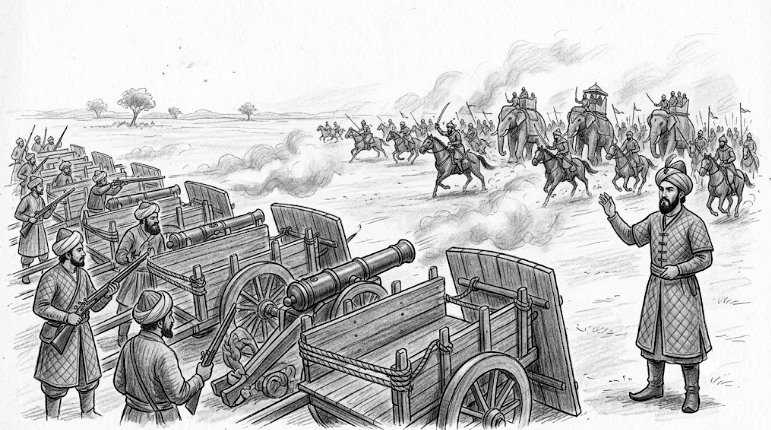
- Babur (1526–1530): Founded the Mughal Empire after defeating Ibrahim Lodi at the First Battle of Panipat (1526); defeated Rana Sanga at Khanwa (1527) and Afghan forces at Ghaghra (1529) using artillery and cart defences.
- Humayun (1530–1540, 1555–1556): Defeated by Sher Shah Suri at Chausa (1539) and Kannauj (1540), went into exile in Safavid Persia, and recaptured Delhi in 1555 with Persian support.
Imperial Consolidation and Expansion (1556–1658)
- Akbar (1556–1605): Ascended the throne as a minor under Bairam Khan, who defeated Hemu at the Second Battle of Panipat (1556); expanded the empire through the Siege of Chittorgarh (1567–1568), Gujarat Campaign (1572–1573), which secured important trade ports, and the Battle of Haldighati (1576) against Maharana Pratap of Mewar.
- Jahangir (1605–1627): Suppressed the rebellion of Prince Khusrau (1606), concluded a negotiated settlement with Maharana Amar Singh of Mewar (1615), consolidated Mughal authority in Bengal, and expanded into the Deccan.
- Shah Jahan (1628–1658): Conducted major Deccan campaigns, subjugating Ahmednagar, Golconda and Bijapur; captured Kangra Fort (1620) and curtailed Portuguese trade influence in Bengal (1631–1632).
Territorial Zenith and Deccan Wars (1658–1707)
- Aurangzeb (1658–1707): Won the war of succession after defeating Dara Shikoh at Dharmat and Samugarh (1658); extended the empire to its greatest territorial extent through the annexation of Bijapur (1686) and Golconda (1687), but spent his final decades in prolonged and resource-intensive campaigns against the Marathas.
Administrative Architecture: Mansabdari and Jagirdari Systems
Mansabdari System
- Introduced by Akbar, the Mansabdari System assigned officials a numerical mansab (rank) determining their status, salary and military obligations.
- Dual rank: Zat determined personal status and salary, while Sawar specified the required cavalry contingent.
- Ranks: Mansabdars—up to 500 Zat; Amirs—500–2,500 Zat; Amir-i-Umda—above 2,500 Zat.
- Du-Aspah Si-Aspah: Introduced by Jahangir, requiring selected mansabdars to maintain twice the cavalry contingent associated with their rank.
Jagirdari System
- Mansabdars were generally paid through jagirs, or land-revenue assignments, whose holders (jagirdars) collected revenue from the assigned territories.
- Jagirs were non-hereditary and periodically transferred to prevent the emergence of local hereditary power bases.
- Lands whose revenues were reserved directly for the imperial treasury were known as Khalisa.
Provincial and Local Administration
- Central officers: Diwan—finance; Mir Bakhshi—military administration and mansabdars; Sadr as-Sudr—religious affairs and grants; Qazi—chief judicial authority.
- Suba: Akbar organised the empire into 12 Subas in 1580, later expanded to 15 after the Deccan conquests; each was jointly administered by a Subedar (governor) and Diwan (revenue administration).
- Sarkar: Subas were divided into districts headed by a Faujdar for law and order and an Amalguzar for revenue collection.
- Pargana: Sarkars were divided into parganas administered by a Shiqdar and Kanungo.
- Village: Local administration involved the Muqaddam and Patwari.
- Chakla: Introduced by Shah Jahan as a cluster of parganas.
- Urban and port administration: Cities were administered by a Kotwal, while port towns were placed under a Mutasaddi.
Revenue Administration: Zabt and Dahsala Systems
- Zabt System: Originating under Sher Shah Suri and refined by Raja Todar Mal under Akbar, the system standardised land-revenue assessment through systematic measurement of land, soil and crop yields (Todar Mal Bandobast).
- Ain-i-Dahsala (1580): Revenue assessment was based on the 10-year average (1570–1580) of crop yields and market prices within regional revenue circles (dastur); land was measured using standardised iron-ringed bamboo rods (tanab) rather than hempen ropes.
- State Demand: Revenue was generally fixed at about one-third of average produce, collected mainly in cash according to fixed rates (dastur-ul-amal).
- Alternative Systems: Outside the Zabt areas, particularly in Bengal and Gujarat, systems such as Ghalla Bakhshi (direct crop sharing) and Kankut (crop estimation) were used; cash-based revenue collection promoted the monetisation of the rural economy.
Religious Policies and Socio-Cultural Initiatives
Akbar’s Pluralism
- Tax Reforms: Akbar abolished the pilgrimage tax and, in 1564, the Jizya imposed on non-Muslims, while extending protection to subjects’ life, property, honour and faith.
- Sulh-i-Kul (Universal Peace): Associated with Abul Fazl, it promoted state neutrality, equal legal protection and freedom of worship; non-Muslims held senior positions, including Raja Todar Mal as finance minister and Raja Man Singh as a leading military commander.
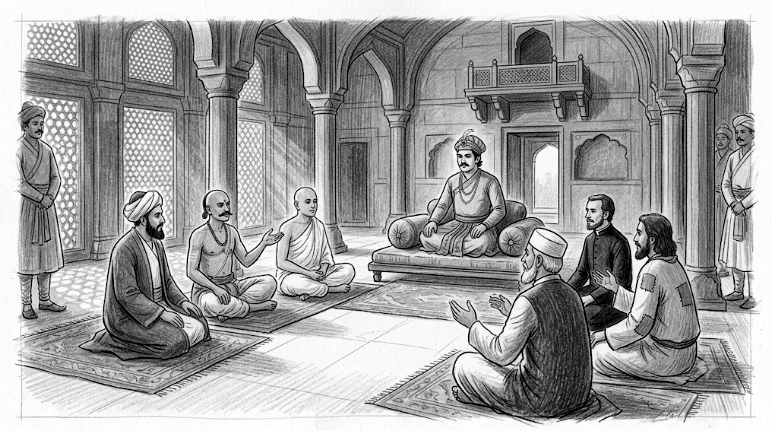
- Ibadat Khana (1575): Established at Fatehpur Sikri for theological debates; initially restricted to Sunni scholars, it was opened in 1578 to Hindu, Jain, Parsi, Christian Jesuit and Sufi scholars.
- Din-i-Ilahi (1582): Also called Tawheed-i-Ilahi, it was a voluntary ethical and intellectual fraternity drawing elements from Sun worship, Jain non-violence and Sufi mysticism, intended to promote unity among the multi-ethnic nobility; Birbal was among its close court adherents.
- Social and Cultural Reforms: Akbar issued measures against forced Sati and child marriage, supported widow remarriage, prohibited the enslavement of war captives, and established the Maktab Khana (translation department), where Sanskrit works including the Mahabharata were translated into Persian as the Razmnama.
Aurangzeb’s Policy Shift
- Religious Policy: Aurangzeb restored more orthodox Islamic administrative practices, re-imposed Jizya in 1679, restricted court music and painting, and ordered the destruction of selected major temples.
Agrarian Economy and Causes of Imperial Decline
Structure of Agrarian Society
- Agrarian structure: The economy was broadly pyramidal, with peasants and artisans as primary producers bearing heavy state taxation, while Zamindars served as hereditary local intermediaries, collected revenue and maintained private armed forces.