
Amendment of the Constitution of India
Meaning of Amendment
- It is a formal change in the Constitution through addition, variation or repeal of its provisions.
- Article 368: Part XX gives Parliament the power and procedure to amend the Constitution.
- Flexible and Rigid: The Constitution combines flexible and rigid methods of amendment.
- Purpose: Amendments help the Constitution adapt to changing social, political and economic needs.
- 24th Amendment, 1971: Clarified Parliament’s power to amend any part of the Constitution, including Fundamental Rights, and made Presidential assent mandatory.
- First Amendment: The first Constitutional Amendment was enacted in 1951.
- Latest Amendment: The 106th Amendment Act, 2023 introduced provisions for women’s reservation in legislatures.
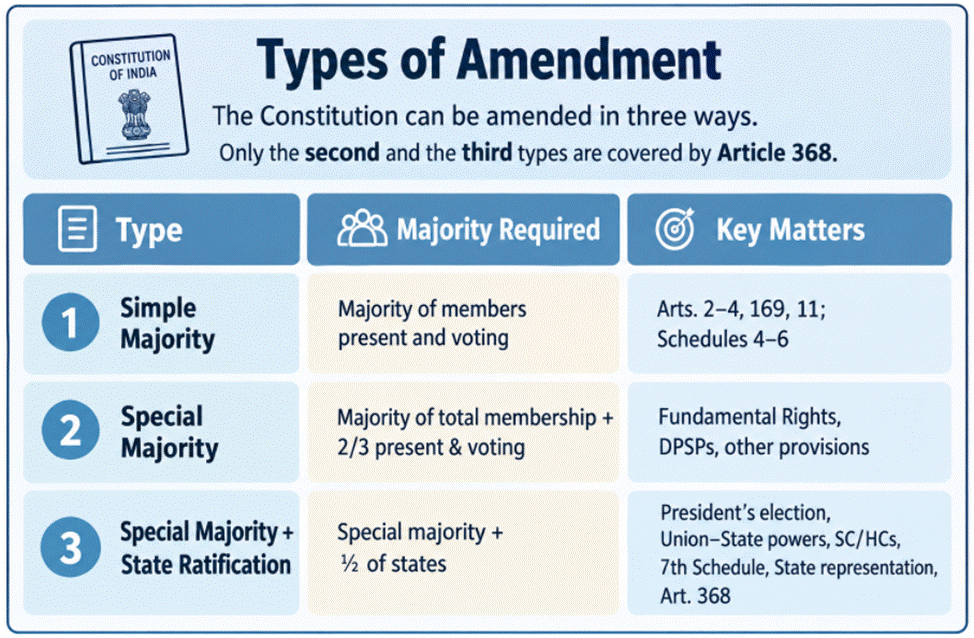
Procedure of Amendment under Article 368
- Introduction: Amendment Bill can be introduced in either House by a Minister or private member; no prior President’s permission is needed.
- Parliamentary Approval: Passed separately by both Houses with the required majority; no joint sitting.
- State Ratification: For federal provisions, at least half of the states must ratify the Bill.
- President’s Assent: The President must give assent and cannot return or withhold the Bill.
- Amendment: After assent, the Bill becomes an Act, amending the Constitution.
Amendment Procedure Borrowed From
| Source | Feature taken |
| Constitution of South Africa | The procedure for amendment of the Constitution (Article 368) Election of the members of the Rajya Sabha |
- The Constituent Assembly adopted a middle path in the amendment procedure so that the Constitution would be neither as rigid as that of the United States nor as flexible as that of the United Kingdom.
- The system of ratification by the states for the amendments affecting federal provisions follows the federal character of the Indian Union.
Important Amendments at a Glance
| Amendment | Year | Subject |
| 1st | 1951 | Ninth Schedule added. New restrictions on freedom of speech and expression. Special provisions for backward classes (Article 15(4)). |
| 7th | 1956 | Reorganisation of states on linguistic basis. Classification of states into Parts A, B, C and D abolished. Union Territories created. |
| 24th | 1971 | Parliament given power to amend Fundamental Rights. Assent of the President made compulsory. |
| 42nd | 1976 | Called the “Mini Constitution”. Changes in the Preamble. Fundamental Duties added. |
| 44th | 1978 | Right to property removed from Fundamental Rights. Safeguards against misuse of Emergency. |
| 52nd | 1985 | Tenth Schedule added. Disqualification of members on the ground of defection. |
| 61st | 1988 | Voting age reduced from 21 years to 18 years. |
| 73rd | 1992 | Constitutional status to Panchayati Raj institutions (Part IX, Eleventh Schedule). |
| 74th | 1992 | Constitutional status to urban local bodies (Part IXA, Twelfth Schedule). |
| 86th | 2002 | Right to Education made a Fundamental Right (Article 21A). |
| 91st | 2003 | Size of the Council of Ministers limited to 15 per cent of the strength of the House. Stricter anti-defection provisions. |
| 97th | 2011 | Constitutional status to co-operative societies (Part IXB). |
| 99th | 2014 | National Judicial Appointments Commission established. Struck down by the Supreme Court in 2015. |
| 100th | 2015 | Land boundary agreement with Bangladesh. Exchange of enclaves. |
| 101st | 2016 | Goods and Services Tax. |
| 102nd | 2018 | Constitutional status to the National Commission for Backward Classes. |
| 103rd | 2019 | Ten per cent reservation for Economically Weaker Sections. |
| 104th | 2019 | Reservation of seats for Scheduled Castes and Scheduled Tribes extended to 2030. Nomination of Anglo-Indians discontinued. |
| 105th | 2021 | Power of states to prepare their own list of Other Backward Classes restored. |
| 106th | 2023 | One-third reservation of seats for women in the Lok Sabha and State Legislative Assemblies. |
PYQs
1. Which Article of the Indian Constitution provides the Parliament the power to amend the Constitution? [Miscellaneous 2018]
(A) Article 360
(B) Article 368
(C) Article 390
(D) Article 356
Answer: (B) Article 368
2. Under which Prime Minister, and in which year, was the voting age in the Indian Constitution amended by reducing it from 21 to 18 years? [Miscellaneous 2019]
(A) Indira Gandhi, 1981
(B) Rajiv Gandhi, 1989
(C) P. V. Narasimha Rao, 1992
(D) Morarji Desai, 1978
Answer: (B) Rajiv Gandhi, 1989
3. The concepts ‘Secular’ and ‘Socialist’ were incorporated into the Preamble of the Constitution of India by which amendment? [Miscellaneous 2019]
(A) 44th Amendment
(B) 42nd Amendment, 1976
(C) 1st Amendment
(D) 52nd Amendment
Answer: (B) 42nd Amendment, 1976
4. Which right below no longer falls under the Fundamental Rights in the Indian Constitution following a constitutional amendment? [Miscellaneous 2012]
(A) Right to Education
(B) Right to Religious Freedom
(C) Right to Property
(D) Right to Equality
Answer: (C) Right to Property
5. By which amendment was the 9th Schedule introduced into the Constitution of India? [Miscellaneous 2014]
(A) 1st Amendment, 1951
(B) 3rd Amendment, 1954
(C) 10th Amendment, 1961
(D) 14th Amendment, 1962
Answer: (A) 1st Amendment, 1951
ভারতীয় সংবিধানের সংশোধন
সংশোধনের অর্থ
- এটি সংবিধানের কোনো বিধির সংযোজন, পরিবর্তন বা বাতিলের মাধ্যমে একটি আনুষ্ঠানিক পরিবর্তন।
- ধারা ৩৬৮: পার্ট ২০ সংসদকে সংবিধান সংশোধন করার ক্ষমতা ও পদ্ধতি প্রদান করে।
- নমনীয় ও অনমনীয়: ভারতীয় সংবিধান সংশোধন পদ্ধতির ক্ষেত্রে নমনীয় এবং অনমনীয়তার সমন্বয় ঘটিয়েছে।
- উদ্দেশ্য: সংবিধান সংশোধন পরিবর্তিত সামাজিক, রাজনৈতিক এবং অর্থনৈতিক প্রয়োজনের সাথে সংবিধানে সামঞ্জস্য বজায় রাখতে সাহায্য করে।
- ২৪তম সংশোধন, ১৯৭১: মৌলিক অধিকার সহ সংবিধানের যেকোনো অংশ সংশোধন করার জন্য সংসদের ক্ষমতাকে স্পষ্ট করেছে এবং রাষ্ট্রপতির সম্মতি বাধ্যতামূলক করেছে।
- প্রথম সংশোধন: প্রথম সংবিধান সংশোধনী ১৯৫১ সালে কার্যকর হয়েছিল।
- সর্বশেষ সংশোধন: ১০৬তম সংশোধন আইন, ২০২৩-এ আইনসভায় নারীদের জন্য সংরক্ষণের বিধান চালু করা হয়েছে।
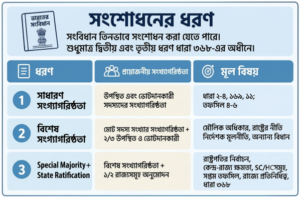
ধারা ৩৬৮ এর অধীনে সংশোধনের পদ্ধতি
- উত্থাপন: সংশোধনী বিলটি কোনো মন্ত্রী বা বেসরকারি সদস্য দ্বারা যেকোনো কক্ষে উত্থাপিত হতে পারে; এর জন্য রাষ্ট্রপতির পূর্বানুমতির প্রয়োজন নেই।
- সংসদের অনুমোদন: প্রয়োজনীয় সংখ্যাগরিষ্ঠতা সহ উভয় কক্ষ দ্বারা পৃথকভাবে পাস হতে হবে; কোনো যৌথ অধিবেশনের সুযোগ নেই।
- রাজ্যের অনুমোদন: যুক্তরাষ্ট্রীয় বিধানের জন্য, কমপক্ষে অর্ধেক রাজ্যকে অবশ্যই বিলটি অনুমোদন করতে হবে।
- রাষ্ট্রপতির সম্মতি: রাষ্ট্রপতিকে অবশ্যই সম্মতি দিতে হবে এবং তিনি বিলটি ফেরত দিতে বা আটকে রাখতে পারেন না।
- সংশোধন: সম্মতির পর, বিলটি একটি আইনে পরিণত হয় এবং সংবিধানকে সংশোধন করে।
সংশোধন পদ্ধতি যেখান থেকে গৃহীত
| উৎস | গৃহীত বৈশিষ্ট্য |
| দক্ষিণ আফ্রিকার সংবিধান | সংবিধান সংশোধনের পদ্ধতি (ধারা ৩৬৮), রাজ্যসভার সদস্যদের নির্বাচন |
- সংবিধান সভা সংশোধন পদ্ধতিতে একটি মধ্যম পন্থা অবলম্বন করেছিল যাতে সংবিধান আমেরিকার মতো অনমনীয় বা যুক্তরাজ্যের মতো অতিরিক্ত নমনীয় না হয়।
- যুক্তরাষ্ট্রীয় কাঠামোকে প্রভাবিত করে এমন সংশোধনের জন্য রাজ্যগুলির দ্বারা অনুমোদনের ব্যবস্থাটি ভারতীয় ইউনিয়নের যুক্তরাষ্ট্রীয় চরিত্রকে অনুসরণ করে।
গুরুত্বপূর্ণ সংশোধনাবলী
| সংশোধন | বছর | বিষয়বস্তু |
| ১ম | ১৯৫১ | নবম তফসিল যুক্ত হয়। বাক ও প্রকাশের স্বাধীনতার ওপর নতুন বিধিনিষেধ। অনগ্রসর শ্রেণীর জন্য বিশেষ বিধান (ধারা ১৫(৪))। |
| ৭ম | ১৯৫৬ | ভাষাগত ভিত্তিতে রাজ্য পুনর্গঠন। পার্ট ক, খ, গ এবং ঘ-তে রাজ্যগুলির শ্রেণীবদ্ধকরণ বাতিল করা হয়েছে। কেন্দ্রশাসিত অঞ্চল তৈরি। |
| ২৪তম | ১৯৭১ | সংসদকে মৌলিক অধিকার সংশোধন করার ক্ষমতা দেওয়া হয়েছে। রাষ্ট্রপতির সম্মতি বাধ্যতামূলক করা হয়েছে। |
| ৪২তম | ১৯৭৬ | একে “ক্ষুদ্র সংবিধান” বলা হয়। প্রস্তাবনায় পরিবর্তন। মৌলিক কর্তব্য যুক্ত হয়। |
| ৪৪তম | ১৯৭৮ | সম্পত্তির অধিকার মৌলিক অধিকার থেকে বাদ দেওয়া হয়। জরুরি অবস্থার অপব্যবহারের বিরুদ্ধে সুরক্ষা। |
| ৫২তম | ১৯৮৫ | দশম তফসিল যুক্ত হয়। দলত্যাগের ভিত্তিতে সদস্যদের অযোগ্যতা। |
| ৬১তম | ১৯৮৮ | ভোটাধিকারের বয়স ২১ বছর থেকে কমিয়ে ১৮ বছর করা হয়। |
| ৭৩তম | ১৯৯২ | পঞ্চায়েতি রাজ প্রতিষ্ঠানকে সাংবিধানিক স্বীকৃতি প্রদান (পার্ট ৯, একাদশ তফসিল)। |
| ৭৪তম | ১৯৯২ | শহরভিত্তিক স্বায়ত্তশাসন সংস্থাকে সাংবিধানিক স্বীকৃতি প্রদান (পার্ট ৯ক, দ্বাদশ তফসিল)। |
| ৮৬তম | ২০০২ | শিক্ষার অধিকারকে মৌলিক অধিকার করা হয় (ধারা ২১ক)। |
| ৯১তম | ২০০৩ | মন্ত্রীপরিষদের আকার কক্ষের মোট সদস্য সংখ্যার ১৫ শতাংশের মধ্যে সীমাবদ্ধ। কঠোর দলত্যাগ বিরোধী বিধান। |
| ৯৭তম | ২০১১ | সমবায় সমিতিগুলিকে সাংবিধানিক মর্যাদা (পার্ট ৯খ)। |
| ৯৯তম | ২০১৪ | জাতীয় বিচার বিভাগীয় নিয়োগ কমিশন গঠন। ২০১৫ সালে সুপ্রিম কোর্ট কর্তৃক বাতিল। |
| ১০০তম | ২০১৫ | বাংলাদেশের সাথে স্থল সীমান্ত চুক্তি। ছিটমহল বিনিময়। |
| ১০১তম | ২০১৬ | পণ্য ও পরিষেবা কর। |
| ১০২তম | ২০১৮ | জাতীয় অনগ্রসর শ্রেণী কমিশনকে সাংবিধানিক মর্যাদা। |
| ১০৩তম | ২০১৯ | অর্থনৈতিকভাবে দুর্বল শ্রেণীর জন্য ১০ শতাংশ সংরক্ষণ। |
| ১০৪তম | ২০১৯ | তপশিলি জাতি ও তপশিলি উপজাতির আসন সংরক্ষণ ২০৩০ সাল পর্যন্ত বৃদ্ধি। অ্যাংলো-ইন্ডিয়ানদের মনোনয়ন বন্ধ। |
| ১০৫তম | ২০২১ | অন্যান্য অনগ্রসর শ্রেণীর নিজস্ব তালিকা তৈরির ক্ষমতা রাজ্যগুলির জন্য পুনর্বহাল। |
| ১০৬তম | ২০২৩ | লোকসভা এবং রাজ্য বিধানসভাগুলিতে নারীদের জন্য এক-তৃতীয়াংশ (১/৩) আসন সংরক্ষণ। |
বিগত বছরের প্রশ্নাবলী
১. ভারতীয় সংবিধানের কোন ধারাটি সংসদকে সংবিধান সংশোধন করার ক্ষমতা প্রদান করে? [মিসলেনিয়াস ২০১৮]
(ক) ধারা ৩৬০
(খ) ধারা ৩৬৮
(গ) ধারা ৩ ৯০
(ঘ) ধারা ৩৫৬
উত্তর: (খ) ধারা ৩৬৮
২. কোন প্রধানমন্ত্রীর অধীনে এবং কোন সালে ভারতীয় সংবিধানে ভোটাধিকারের বয়স ২১ বছর থেকে কমিয়ে ১৮ বছর করা হয়েছিল? [মিসলেনিয়াস ২০১৯]
(ক) ইন্দিরা গান্ধী, ১৯৮১
(খ) রাজীব গান্ধী, ১৯৮৯
(গ) পি. ভি. নরসিমা রাও, ১৯৯২
(ঘ) মোরারজি দেশাই, ১৯৭৮
উত্তর: (খ) রাজীব গান্ধী, ১৯৮৯
৩. ভারতীয় সংবিধানের প্রস্তাবনায় ‘ধর্মনিরপেক্ষ’ এবং ‘সমাজতান্ত্রিক’ ধারণা দুটি কোন সংশোধনীর মাধ্যমে অন্তর্ভুক্ত করা হয়েছিল? [মিসলেনিয়াস ২০১৯]
(ক) ৪৪তম সংশোধন
(খ) ৪২তম সংশোধন, ১৯৭৬
(গ) ১ম সংশোধন
(ঘ) ৫২তম সংশোধন
উত্তর: (খ) ৪২তম সংশোধন, ১৯৭৬
৪. সংবিধান সংশোধনের পর নিচের কোন অধিকারটি ভারতীয় সংবিধানে আর মৌলিক অধিকারের অধীনে পড়ে না? [মিসলেনিয়াস ২০১২]
(ক) শিক্ষার অধিকার
(খ) ধর্মীয় স্বাধীনতার অধিকার
(গ) সম্পত্তির অধিকার
(ঘ) সাম্যের অধিকার
উত্তর: (গ) সম্পত্তির অধিকার
৫. কোন সংশোধনীর মাধ্যমে ভারতীয় সংবিধানে ৯ম তফসিল যুক্ত করা হয়েছিল?
[মিসলেনিয়াস ২০১৪]
(ক) ১ম সংশোধন, ১৯৫১
(খ) ৩য় সংশোধন, ১৯৫৪
(গ) ১০ম সংশোধন, ১৯৬১
(ঘ) ১৪তম সংশোধন, ১৯৬২
উত্তর: (ক) ১ম সংশোধন, ১৯৫১