
Amendment of the Constitution of India
Meaning of Amendment
- It is a formal change in the Constitution through addition, variation or repeal of its provisions.
- Article 368 of Part XX gives Parliament the power and procedure to amend the Constitution through Special majority and Special majority with ratification of half of the state legislatures. (There are other provisions mentioned in the constitution that enables the Parliament to amend the Constitution by simple majority, though such provisions are not a part of Article 368.)
- Flexible and Rigid: The Constitution combines flexible and rigid methods of amendment.
- Purpose: Amendments help the Constitution adapt to changing social, political and economic needs.
- 24th Amendment, 1971: Clarified Parliament’s power to amend any part of the Constitution(without altering the Basic Structure of the constitution), including Fundamental Rights, and made Presidential assent mandatory.
- First Amendment: The first Constitutional Amendment was enacted in 1951.
- Latest Amendment: The 106th Amendment Act, 2023 introduced provisions for women’s reservation in legislatures.
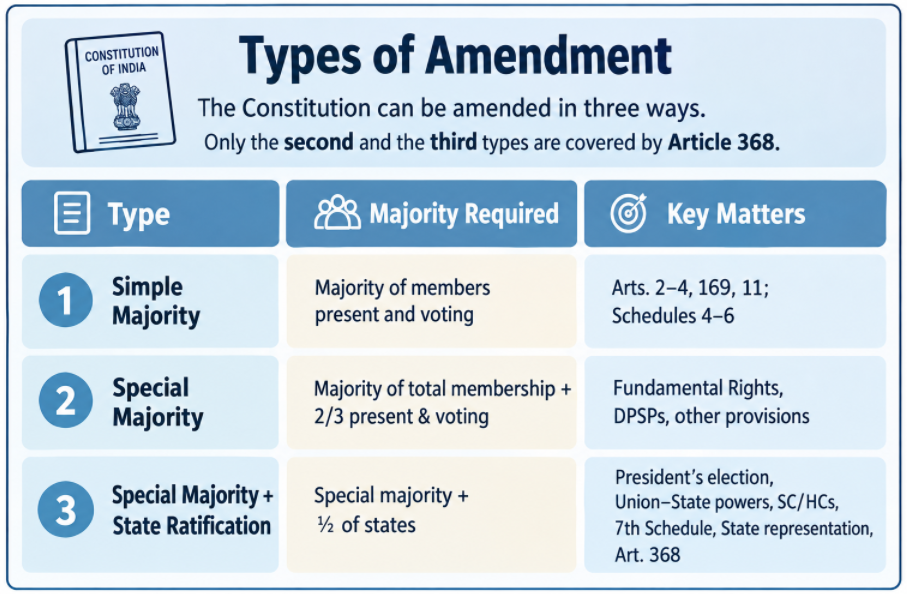
Procedure of Amendment under Article 368
- Introduction: An amendment bill can be introduced in either House by a Minister or private member; no prior President’s permission is needed.
- Parliamentary Approval: Passed separately by both Houses with the required majority; no joint sitting.
- State Ratification: For federal provisions, at least half of the states must ratify the Bill.
- President’s Assent: The President must give assent and cannot return or withhold the Bill.
- Amendment: After assent, the Bill becomes an Act, amending the Constitution.
Amendment Procedure Borrowed From
| Source | Feature taken |
|---|---|
| Constitution of South Africa | The procedure for amendment of the Constitution (Article 368)Election of the members of the Rajya Sabha |
- The Constituent Assembly adopted a middle path in the amendment procedure so that the Constitution would be neither as rigid as that of the United States nor as flexible as that of the United Kingdom.
- The system of ratification by the states for the amendments affecting federal provisions follows the federal character of the Indian Union.
Important Amendments at a Glance
| Amendment | Year | Subject |
|---|---|---|
| 1st | 1951 | Ninth Schedule added. New restrictions on freedom of speech and expression. Special provisions for backward classes (Article 15(4)). |
| 7th | 1956 | Reorganisation of states on linguistic basis. Classification of states into Parts A, B, C and D abolished. Union Territories created. |
| 24th | 1971 | Parliament given power to amend Fundamental Rights. Assent of the President made compulsory. |
| 42nd | 1976 | Called the “Mini Constitution”. Changes in the Preamble. Fundamental Duties added. |
| 44th | 1978 | Right to property removed from Fundamental Rights. Safeguards against misuse of Emergency. |
| 52nd | 1985 | Tenth Schedule added. Disqualification of members on the ground of defection. |
| 61st | 1988 | Voting age reduced from 21 years to 18 years. |
| 73rd | 1992 | Constitutional status to Panchayati Raj institutions (Part IX, Eleventh Schedule). |
| 74th | 1992 | Constitutional status to urban local bodies (Part IXA, Twelfth Schedule). |
| 86th | 2002 | Right to Education made a Fundamental Right (Article 21A). |
| 91st | 2003 | Size of the Council of Ministers limited to 15 per cent of the strength of the House. Stricter anti-defection provisions. |
| 97th | 2011 | Constitutional status to co-operative societies (Part IXB). |
| 99th | 2014 | National Judicial Appointments Commission established. Struck down by the Supreme Court in 2015. |
| 100th | 2015 | Land boundary agreement with Bangladesh. Exchange of enclaves. |
| 101st | 2016 | Goods and Services Tax. |
| 102nd | 2018 | Constitutional status to the National Commission for Backward Classes. |
| 103rd | 2019 | Ten per cent reservation for Economically Weaker Sections. |
| 104th | 2019 | Reservation of seats for Scheduled Castes and Scheduled Tribes extended to 2030. Nomination of Anglo-Indians discontinued. |
| 105th | 2021 | Power of states to prepare their own list of Other Backward Classes restored. |
| 106th | 2023 | One-third reservation of seats for women in the Lok Sabha and State Legislative Assemblies. |