
Fundamental Rights
Meaning of Fundamental Rights
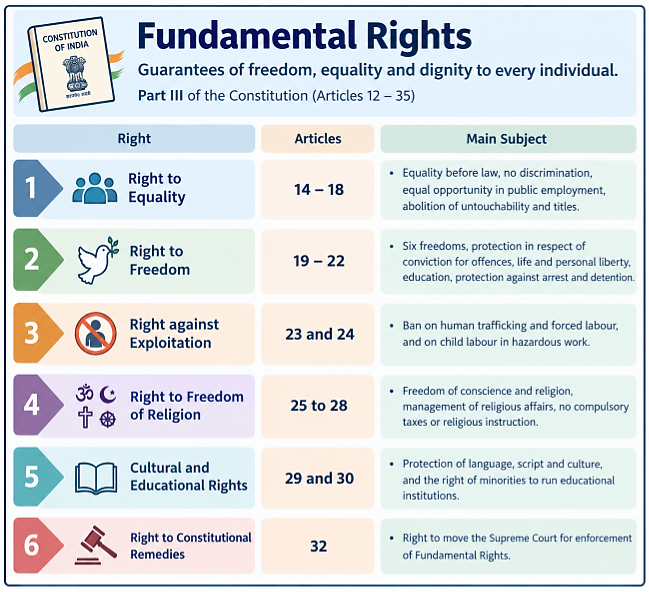
- Location: Fundamental Rights are contained in Part III (Articles 12 to 35) of the Constitution.
- Meaning: They are the basic rights of every person, guaranteed by the Constitution and protected by the courts against the arbitrary action of the legislature and the executive.
- Magna Carta of India: Part III is called the Magna Carta of India. The idea of a list of enforceable rights was taken from the Bill of Rights of the United States.
- Amendable: Parliament can amend Fundamental Rights by the special majority under Article 368, but not in a way that destroys the Basic Structure.
- Different from Directive Principles: Fundamental Rights can be enforced in a court of law, but Directive Principles of State Policy cannot.
Article 12: Definition of State
- The State includes the Government and Parliament of India, the government and legislature of each state, all local authorities such as municipalities and panchayats, and other authorities within the territory of India or under the control of the Government of India.
- Most Fundamental Rights are available only against the State. Articles 15(2), 17, 23 and 24 are also available against private persons.
Article 13: Laws Inconsistent with Fundamental Rights
- Laws in force before the Constitution and laws made after it are void to the extent of inconsistency with Fundamental Rights. This is the basis of judicial review.
- Doctrine of Severability: only the part of a law which is inconsistent is void, if it can be separated from the rest.
- Doctrine of Eclipse: a pre-Constitution law which is inconsistent is not dead but remains in a shadow, and revives if the inconsistency is removed.
- Article 13(4): inserted by the 24th Amendment, 1971. A constitutional amendment under Article 368 is not a “law” under Article 13.
Classification of Fundamental Rights
- Originally the Constitution gave seven Fundamental Rights. The Right to Property (Article 31) was removed from Part III by the 44th Amendment Act, 1978 and made a legal right under Article 300A in Part XII.
- At present there are six Fundamental Rights.
Fundamental Rights Borrowed From
| Source | Feature taken |
|---|---|
| Constitution of the United States | The list of Fundamental Rights (Bill of Rights)Equal protection of the laws (Article 14)Judicial review |
| Constitution of the United Kingdom | Equality before law and rule of law (Article 14)The system of writs (Article 32 and Article 226) |
| Constitution of Japan | Procedure established by law (Article 21) |
- The Constituent Assembly took the idea of rights from other countries but adjusted them to Indian needs by adding reasonable restrictions and special provisions for backward classes, women and children.
Right to Equality (Articles 14–18)
Ensures equal treatment before the law and prohibits discrimination on grounds of religion, race, caste, sex, or place of birth.
- Art. 14: Equality before law and equal protection of laws.
- Art. 15: Prohibition of discrimination.
- Art. 16: Equality of opportunity in public employment.
- Art. 17: Abolition of Untouchability.
- Art. 18: Abolition of titles (except military and academic distinction).
Right to Freedom (Articles 19–22)
Guarantees individual liberties necessary for a democratic society.
Art. 19: Guarantees 6 basic freedoms:
1. Speech and expression
2. Peaceful assembly (without arms)
3. Form associations or unions
4. Move freely throughout India
5. Reside and settle in any part of India
6. Practice any profession, trade, or business
Art. 20: Protection in respect of conviction for offenses (protection against self-incrimination, double jeopardy, and ex-post-facto laws).
Art. 21: Protection of life and personal liberty.
Art. 21A: Right to education (free and compulsory education for ages 6–14). Added by 86th Amendment 2002.
Art. 22: Protection against arbitrary arrest and detention.
Right Against Exploitation (Articles 23–24)
Protects vulnerable individuals from forced labor and hazardous employment.
Art. 23: Prohibition of human trafficking and forced labor (begar).
Art. 24: Prohibition of employment of children (under 14) in factories, mines, and hazardous occupations.
Right to Freedom of Religion (Articles 25–28)
Ensures secularism and freedom of conscience for all individuals.
Art. 25: Freedom of conscience and free profession, practice, and propagation of religion.
Art. 26: Freedom to manage religious affairs.
Art. 27: Freedom from payment of taxes for promotion of any particular religion.
Art. 28: Freedom from attending religious instruction in certain educational institutions.
Cultural and Educational Rights (Articles 29–30)
Protects minority communities (linguistic and religious) to preserve their distinct culture and establish educational institutions.
Art. 29: Protection of language, script, and culture of minorities.
Art. 30: Right of minorities to establish and administer educational institutions.
Right to Constitutional Remedies (Article 32)
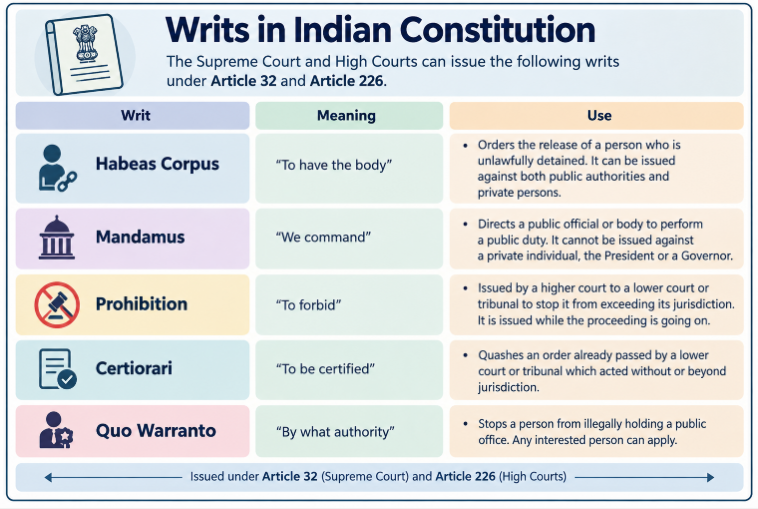
Dr. B.R. Ambedkar called Article 32 the “Heart and Soul of the Constitution.” It allows citizens to directly move the Supreme Court for enforcement of fundamental rights through writs:
Habeas Corpus: “To have the body of” (against illegal detention).
Mandamus: “We command” (directing a public official to perform a duty).
Prohibition: Prevents lower courts from exceeding jurisdiction.
Certiorari: Quashes an illegal order of a lower court or tribunal.
Quo-Warranto: “By what authority?” (prevents illegal usurpation of a public office).
Citizens and Foreigners
| Available to | Articles |
|---|---|
| Citizens only | 15, 16, 19, 29 and 30 |
| Citizens and foreigners (except enemy aliens) | 14, 20, 21, 21A, 22, 23, 24, 25, 26, 27 and 28 |
Special Provisions and Limits
Article 31A: Saves laws providing for acquisition of estates and similar rights from challenge under Articles 14 and 19 (added by the 1st Amendment).
Article 31B: Saves the laws placed in the Ninth Schedule from challenge. Laws placed after 24 April 1973 can be reviewed on the ground of Basic Structure.
Article 31C: Saves laws made to give effect to Directive Principles in Article 39(b) and (c).
Article 33: Parliament can restrict or cancel the Fundamental Rights of members of the armed forces, the police and similar forces, to ensure discipline.
Article 34: Restriction on Fundamental Rights while martial law is in force.
Article 35: Only Parliament, and not State Legislatures, can make laws on certain matters, such as Article 16(3), Article 32(3), Article 33 and punishment for offences under Part III.
Suspension during Emergency
Article 358: The six freedoms of Article 19 are suspended automatically only during a National Emergency declared on the ground of war or external aggression. They are not suspended in an emergency on the ground of armed rebellion.
Article 359: During a National Emergency the President can, by an order, suspend the right to move the courts for the enforcement of Fundamental Rights, except Articles 20 and 21, which remain enforceable at all times (44th Amendment, 1978).